
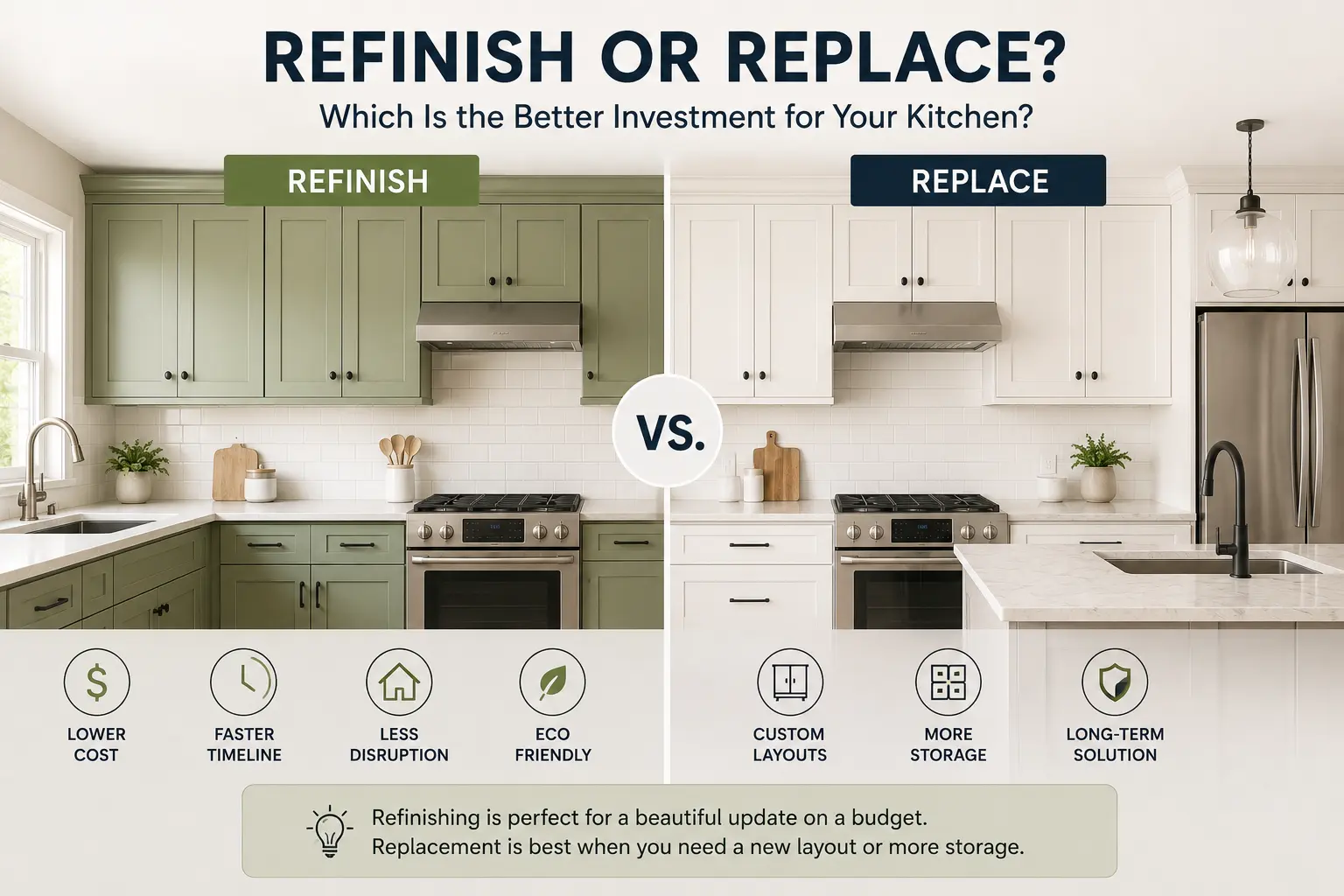
You’re standing in your kitchen looking at cabinets that just don’t do it for you anymore. Maybe the finish has worn thin around the handles, or the color feels dated next to newer countertops and flooring. The question that follows is almost always the same: do you paint what you have, or tear it out and start fresh?
It’s a fair question, and it trips up a lot of homeowners in Richmond and the surrounding area. Search “cabinet painting vs replacement,” and you’ll find dozens of opinions, most written by companies that only offer one of the two services. That’s not what this guide is. We’ll walk through both options honestly, including the cases where replacement genuinely beats refinishing, so you can decide based on your kitchen rather than on whoever wrote the loudest blog post.
At-a-Glance: Which Option Fits Your Goal?
| If your goal is… | Best Option |
| Save money | Cabinet Refinishing |
| Change your kitchen layout | Cabinet Replacement |
| Finish the project quickly | Cabinet Refinishing |
| Install custom cabinetry | Cabinet Replacement |
| Increase resale appeal on a budget | Cabinet Refinishing |
The Job You’re Really Trying to Get Done
Before you pick a side, it helps to name what you actually want out of this project. Most homeowners land on some combination of:
- A kitchen that looks current, not stuck in a past decade
- A project that doesn’t blow up the household budget
- A finished result that holds up to daily use
- A timeline that doesn’t turn into months of takeout dinners
- Confidence that you didn’t overpay for something you didn’t need
Notice none of those goals actually says “replace the cabinets” or “paint the cabinets.” Those are just two paths to the same destination. Once you’re clear on what you’re solving for, the decision gets a lot easier.
What’s Making This Decision So Difficult?
If it were simple, you wouldn’t be reading this. A few things tend to muddy the water:
- Replacement costs can be shockingly high once countertops, plumbing, and electrical get involved
- Every contractor you talk to seems to recommend a different option
- You’re not sure if your cabinet boxes are even in good enough shape to refinish
- You’ve heard stories about painted cabinets chipping or peeling within a year
- Nobody wants to spend money twice because they chose wrong the first time
That last point is really what this guide is here to prevent.
Option 1: Cabinet Refinishing
Cabinet refinishing, sometimes called cabinet restoration or a cabinet makeover, means keeping your existing cabinet boxes, doors, and drawers in place and giving them an entirely new painted finish. Done right, this isn’t a quick brush-and-go job. It starts with cleaning and degreasing every surface, sanding to create a profile the paint can grip, filling dents or dings, priming, and then applying multiple coats of a durable finish, usually sprayed rather than brushed for a smooth, factory-like result.
For kitchen cabinet painting specifically, most professional jobs run somewhere between one and two weeks, and your kitchen stays largely functional the whole time since demolition isn’t part of the process. You keep your layout, your cabinet hardware locations, and your existing storage configuration. What changes is the color and the finish quality.
Option 2: Cabinet Replacement
Replacement means exactly what it sounds like: your existing cabinets come out, and new ones go in. This is a bigger undertaking than most people expect, because cabinets rarely exist in isolation. Removing them usually means disconnecting plumbing under the sink, temporarily pulling countertops, and sometimes touching electrical for under-cabinet lighting or outlets built into the cabinet run.
Once demolition is done, new cabinet boxes get installed, leveled, and secured, followed by new countertops (since old ones almost never fit new cabinet dimensions), and then reconnecting plumbing and appliances. This process commonly takes several weeks depending on cabinet lead times and the complexity of the layout change. Replacement is the right call when you’re changing your kitchen’s actual layout, not just its appearance.
How to Decide Which Option Is Right for You
Before comparing costs side by side, run through this quick checklist:
- Are your cabinet boxes structurally sound, with no water damage or warping?
- Do you like your current kitchen layout and storage configuration?
- Are you planning a full kitchen remodel, or just updating the look?
- Is your main goal to change the appearance, or to redesign the space itself?
- What does your realistic renovation budget look like?
- How many more years do you plan to stay in this home?
If your boxes are solid and your layout works, refinishing usually gets you there. If you answered “no” to the first two questions, replacement probably deserves a closer look.
Cabinet Refinishing vs. Replacement, Side by Side
| Factor | Cabinet Refinishing | Cabinet Replacement |
| Cost | Lower | Significantly higher |
| Timeline | About 1-2 weeks | Several weeks or more |
| Disruption to daily life | Minimal | Kitchen out of commission |
| Works with existing layout | Yes | Layout can change |
| Environmental impact | Less waste | More demolition waste |
| Return on investment | Strong, low cost per impact | Strong, but higher upfront spend |
When Cabinet Refinishing Makes Sense
- Your cabinet boxes are structurally sound
- Your current layout already works for how you cook and store things
- You want a new color, not a new floor plan
- You’re preparing to sell and want a strong return without a big spend
- Budget is a real constraint
- You want the project done in a couple of weeks, not months
When Replacement Makes More Sense
- There’s water damage around the sink or dishwasher
- Cabinet boxes are warped, swollen, or structurally compromised
- You’re doing a full kitchen redesign, moving appliances or walls
- You need significantly more storage than your current layout provides
- You’ve outgrown the layout itself, not just the finish
How Much Can You Actually Save?
The savings from refinishing come from everything you don’t have to pay for. Replacement isn’t just the cost of cabinet boxes; it’s labor to remove and haul away the old ones, disposal fees, new countertops because old ones rarely fit new boxes cleanly, and often plumbing and electrical work to reconnect everything. Refinishing skips nearly all of that. You’re paying for prep, materials, and skilled labor to apply the finish, not for demolition, disposal, or a countertop replacement you didn’t plan for. That’s why refinishing typically lands well below replacement, even when both are done by a professional rather than a DIY weekend project.
Will Cabinet Refinishing Last?
This is the question that stops a lot of homeowners from painting kitchen cabinets, and it’s a fair one. The honest answer is that it depends almost entirely on the process, not the paint can. Surface preparation determines whether the finish bonds properly or starts lifting within a year. A quality primer built for cabinetry, applied correctly, gives the topcoat something to hold onto. Professional spraying, rather than brushing or rolling, is what produces that smooth, factory-style finish instead of visible brush strokes. And the finish itself needs proper cure time before cabinets go back into daily use, or you risk soft spots and fingerprints in the paint. Cabinets refinished with the right prep, primer, and spray application can hold up for years of daily use with basic care, which is why choosing experienced cabinet painters matters more than choosing a specific paint brand.
Questions to Ask Before Deciding
- What condition are my cabinet boxes actually in?
- Does my current layout work, or am I fighting it every time I cook?
- Am I planning a full remodel down the road, or is this a standalone update?
- What’s my real budget, not just my ideal one?
- How soon do I need this finished?
- Am I trying to sell soon, or settle in for the long haul?
Real-Life Examples
Take a kitchen with solid wood cabinet boxes and a layout the homeowner actually likes. The finish is dated, the color feels heavy, but the bones are good. That’s a textbook refinishing situation. Same square footage, same storage, a completely different look, at a fraction of what a full gut renovation would cost.
Now picture a kitchen where the sink cabinet has been slowly absorbing water for years, the base is swollen, and the homeowner wants an island where there currently isn’t room for one. No amount of paint fixes structural damage or adds square footage. That’s a replacement job, and pretending otherwise would just be an expensive delay.
How Brush & Build Helps Homeowners Make the Right Decision
We start every cabinet project with an honest look at your kitchen, not a sales pitch. That means checking whether your cabinet boxes are actually solid enough for refinishing, talking through your layout and long-term plans, and giving you a straight recommendation, even when that recommendation is that you might want to consider replacement instead. Our job is to help you make the right call for your kitchen and your budget, then deliver a finish that actually holds up, using proper prep, primers, and professional spray application on every project we take on in the Richmond area.
Frequently Asked Questions
Is cabinet refinishing worth it?
For cabinets with solid boxes and a layout you’re happy with, yes. You get a meaningfully different look at a fraction of replacement cost, without the disruption of a full renovation.
Can you paint laminate cabinets?
Yes, with the right primer designed to bond to laminate surfaces. Skipping this step is the most common reason laminate cabinet paint jobs fail.
Is cabinet painting cheaper than replacing cabinets?
In most cases, yes, often significantly. Refinishing avoids demolition, disposal, and new countertop costs, which make up a large share of a replacement budget.
Do painted cabinets chip easily?
Poorly prepped and hand-brushed cabinets chip easily. Properly primed, sprayed, and cured cabinets are far more durable and resist chipping under normal daily use.
What’s the difference between cabinet refinishing and cabinet refacing?
Refinishing repaints your existing doors and boxes. Refacing replaces the door and drawer fronts with new ones while keeping the existing boxes, which costs more than refinishing but less than full replacement.
Does cabinet refinishing increase home value?
Updated cabinets are consistently one of the higher-return kitchen updates, and refinishing delivers much of that visual impact at a lower cost than a full cabinet replacement.
How long do professionally painted cabinets last?
With proper prep, primer, and a sprayed finish, professionally painted cabinets can look great for years before needing a refresh.
Conclusion
There’s no universal right answer here, and anyone who tells you there is hasn’t actually looked at your kitchen. The right choice depends on the condition of your cabinet boxes, whether your current layout works for how you live, your budget, and how long you plan to stay in your home. If your cabinets are structurally sound and your layout works, refinishing will likely get you the update you’re after for a lot less money and disruption. If you’re dealing with damage or a layout that’s never worked for you, replacement is worth the investment. If you’re unsure which option makes the most sense, start with a professional evaluation rather than making assumptions based on online estimates. A qualified cabinet refinishing contractor can tell you whether your existing cabinets are worth saving and help you invest where it matters most.